What actually changes when you pool capital from five members to trade crypto and options with automation — the strategy, the infrastructure, the risk controls, and the law that decides which of them you are allowed to run.
Prepared 30 October 2026
Prepared forEli Kluzner and the founding members
ScopeStrategy audit, architecture, legal and tax structure, build plan
82.9%of months a 16-delta index condor finishes profitable — the win rate is not the problem
3.0 : 1average loser ($1,034) to average winner ($345). One bad month erases three good ones
11.9%of the premium you collect goes to commission and slippage at one lot. This single ratio decides which strike geometry survives
+$109net expectancy per condor on $2,500 of risk, after $45 of friction — the entire edge
#
Number
Value
Why it matters
1
Members
5
One passive member converts a club into a securities offering. This is the fork in every legal question that follows.
2
Win rate, base condor
82.9%
High enough to feel safe for years, which is exactly why the loss side has to be designed before the win side.
3
Average loser / average winner
3.0 : 1
$1,034 against $345. Any sizing rule that ignores this is arithmetic theatre.
4
Worst single condor
−$2,143
86% of the maximum risk, on $2,500. Defined risk is not low risk.
5
Net expectancy per condor
+$109
4.4% of the risk committed, per month. That is the whole business.
6
Friction as a share of premium
11.9%
At a 5-point wing the same friction is 54.7% and the trade is dead. Geometry is a cost decision.
7
Median 12-month return, 5% sizing
+3.4%
Below an index fund's long-run average. The product is drawdown control, not return.
8
Cross-venue arbitrage cost wall
24 bps
Typical divergence between liquid venues is 1–10 bps. The strategy is unavailable to you.
9
Measured BTC funding, annualised
4.90%
Mean of 720 eight-hour periods to 30 October 2026. Real, thin, and not free of counterparty risk.
10
Real IBKR commission, 4-leg condor round trip
$8.00
Which means the $45 in the model is almost entirely slippage — so the operational lever is order placement, not broker shopping.
The short answer
Three of the four frameworks in the brief are wrong for a five-person club, and the fourth is a research tool rather than a bot. Cross-exchange arbitrage is no longer a strategy Hummingbot ships and has never been viable at retail fee tiers. Grid trading is not market-neutral; it is a short-volatility position with a directional tail. Funding carry is a real but thin premium that shrinks to roughly 3% a year on capital once the margin haircut is counted. Only delta-selected short premium has a measurable, replicable edge — and it produces about 3.4% a year at sensible sizing with a 3:1 loss-to-win ratio.
The harder work is not the code. It is that pooling capital from five people turns a hobby into an issuer of securities, and a bot that picks the trades is exactly the fact pattern the SEC has said makes members passive.
Contents
What is in this document
01The verdict4
02Mandate, assumptions, and the four questions only you can answer7
03What changes when five people share a book9
04Legal architecture: the fork, and what sits on each side11
05Tax architecture: the XSP decision and the purity rule15
06Strategy audit: grading the four candidates on evidence18
07The options engine: a full specification20
08The crypto sleeve: what survives the fee schedule24
09The risk engine: one brain, hard limits, one kill switch26
10Technical architecture: what to take from each framework, and what to write28
11The execution and data stack, priced30
12Operations: the runbook nobody writes until it is too late32
13Governance: the clauses that stop a bad month becoming an ending34
How to read this. Sections 1–3 are the argument and you should read them in order. Sections 4–5 are a checklist for a lawyer and a CPA, not a substitute for either. Sections 6–9 are the trading specification. Sections 10–13 are the build and the operating manual. Sections 14–16 are the plan and the money. Section 17 is the part that most proposals leave out: the conditions under which this should be stopped.
Every number attributed to the strategy comes from sim/club_sim.py in the companion folder and regenerates with one command. Every legal and tax statement carries a citation to a primary source in Appendix A.4. Where something could not be verified, the text says so.
Section 01
The verdict
The brief proposes four open-source frameworks as the technical foundation and two strategies as the commercial one: cross-exchange arbitrage and grid trading in crypto, delta-neutral iron condors in options. It asks for a plan to build "a bot just like these four repositories."
The frameworks are real and the licences are as described. The strategies, as a package, are not a business. Three of the four fail on measurable grounds, and the fourth is a research engine that needs a trading system wrapped around it. What follows is why, and what to build instead.
What each framework actually is in October 2026
Framework
Licence
What it really does for you
Verdict
Hummingbot v2.17.0, 22 Sep 2026
Apache 2.0
The best open connector library in crypto — 40+ exchange WebSocket adapters, battle-tested order management, a real paper-trading mode. It is a connector and execution layer, not a strategy. The classic V1 arbitrage strategy no longer exists in the repository; what remains is the V2 arbitrage_executor, which sends market orders on both legs and refuses to start unless both venues are already funded.
Keep as a library. Not as a strategy.
Freqtrade release 2026.10
GPL-3.0
A well-built crypto backtester and strategy runner with hyperparameter search and a competent ML add-on. GPLv3 §2 imposes conditions only on conveying, so running it on the club's own capital creates no obligation — the licence is a non-issue unless you distribute the bot.
Optional. Nothing it does is uniquely necessary.
OpenAlgo
AGPL / MIT mix
A multi-broker bridge built around Indian brokers, with a no-code strategy builder and an LLM chat panel. It has no US equity-options coverage and no US crypto venue coverage. For this mandate it is not a candidate.
Exclude.
QuantConnect LEAN
Apache 2.0
The only open engine that models listed options properly — chains with quotes, expiries, assignment, multi-leg fills, and a universe-selection framework. That is the hard part of options research and nobody else in the list attempts it.
The research brain. Non-negotiable.
The practical consequence: you are not choosing between four bots. You are choosing one research engine (LEAN), one optional crypto connector (Hummingbot), and a decision about how much of your own execution and risk layer to write. That decision is not close — you write the layer, because it is the only part that belongs to you and the only part that can hold a kill switch that works.
Why cross-exchange arbitrage is not available to you
This is the clearest of the four. Arbitrage is a race decided by three things: fee tier, latency, and pre-positioned inventory. A club trading $50,000 to $500,000 has none of them.
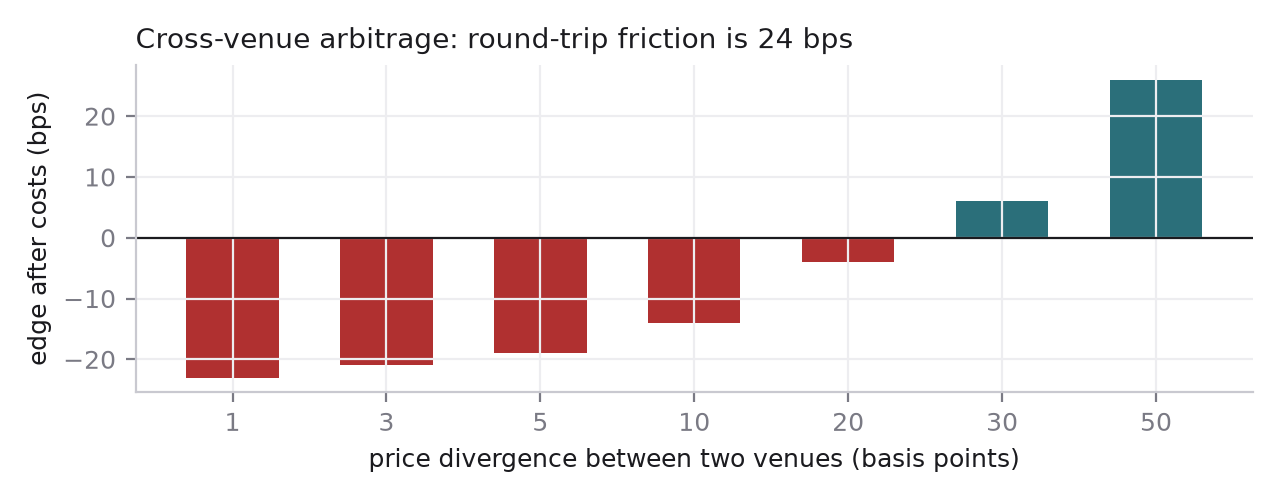
The fee arithmetic is unforgiving. Two taker legs at 10 bps each, plus two basis points of slippage per side, is a 24-basis-point round trip before you have made a cent. The price divergence between two liquid venues on BTC/USDT, seen by a participant with 100–300 ms of retail latency, is typically one to ten basis points — and the moments it exceeds twenty-four are exactly the moments one venue is failing.
Round-trip friction is 24 bps at retail fee tiers. The strategy only pays above that line, and the divergences that large are not trading opportunities — they are outages. Cost model: 10 bps taker per leg, 2 bps slippage per side.
Hummingbot's own documentation says the same thing less bluntly. Its academy page describes arbitrage as a race where "profitability [is] determined by milliseconds", against firms investing billions, and concludes that "as arbitrage gets increasingly competitive, opportunities become increasingly hard to come by… Arbitrageurs may search for opportunities for long periods of time but are not guaranteed to find them." The V2 executor's default min_profitability is 1% — a threshold roughly two orders of magnitude above live centralized-exchange spreads. That default is not a tuning parameter; it is the maintainers telling you who the strategy is for.
The operational detail that settles it. The V2 arbitrage executor has no transfer or rebalancing logic. It requires the base asset to be sitting on the selling venue and the quote asset on the buying venue before it will fire, and it stops with INSUFFICIENT_BALANCE otherwise. To run it continuously you must pre-fund both sides — doubling your capital requirement and parking half of it on the venue you are not trading. For a club with a $50k crypto allocation that is $50k of inventory to capture spreads of a few basis points.
Why grid trading is not what the brief thinks it is
Grid trading is described in the brief as a way to "capture micro-spreads" and sit alongside arbitrage as a market-neutral strategy. It is neither. Hummingbot's own documentation is explicit about what a grid profits from: "price oscillations within a range", listed as "particularly useful for: Range-bound markets."
Inside the range you are selling volatility and collecting the oscillation. When price leaves the range, the documented behaviour is to stop placing orders and — with keep_position: true, the default in the example configuration — retain the accumulated inventory in a hold bucket. There is no hedge. A grid below the market that price falls through leaves you long the entire ladder, at every rung, into a decline you did not forecast.
That is a short-volatility position with a directional tail, and it is the same risk shape as the options sleeve — except the options sleeve has a defined maximum loss and the grid does not. Running both and calling it diversification would be running one bet twice.
What survives, and what it is worth
Two things survive contact with the arithmetic: delta-selected short premium on a broad-based index, and — at a much smaller size and with real caveats — the crypto funding carry. Everything in Sections 6 through 9 is about running those two properly.
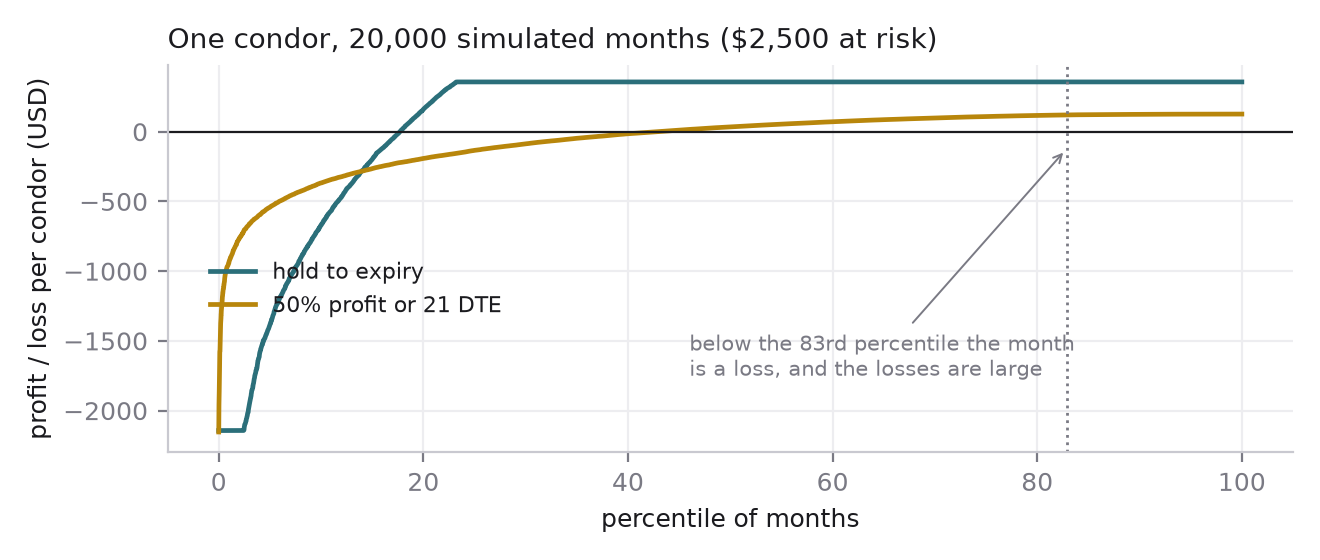
What short premium is worth is the number that should govern every other decision. A 30-day, 25-point-wide, 16-delta iron condor on XSP collects about $380 against $2,500 of risk — 15.2% of the risk. Simulated over 20,000 months with a realistic volatility risk premium and fat tails, it wins 82.9% of the time, averages +$345 when it wins and −$1,034 when it loses, and nets +$109 per condor after $45 of friction.
The shape of the business. Above the 83rd percentile the month is a loss, and the losses are an order of magnitude larger than the wins. Managing the position at 50% profit or 21 days to expiry (gold) truncates the tail and, in this model, gives up more expectancy than it saves — which is a finding, not an opinion, and Section 7 shows the trade-off explicitly.
At 5% of capital at risk per condor, twelve sequential months produce a median return of +3.4%, a fifth-percentile outcome of −4.4%, and a median maximum drawdown of 4.3%. At 20% sizing the median rises to +13.8% and the median maximum drawdown to 17%, with a 14% chance of a drawdown beyond 30%.
That is the honest profile: a modest, real, capacity-limited premium, harvested with a 3:1 loss-to-win ratio, which is worth running only because the alternative uses of the capital are worse on a risk-adjusted basis — not because it beats an index fund on return. It does not.
What I recommend
Build one sleeve, not two. The options sleeve on XSP, specified in Section 7, with LEAN as the research engine and roughly 1,500 lines of your own Python for execution, risk and reconciliation. Put the crypto allocation on paper for the first year and fund it only if the options sleeve has run twelve months inside its limits, because the funding carry is worth about 3% a year on capital and carries exchange counterparty risk that a five-person club is badly placed to absorb.
Section 02
Mandate, assumptions, and four questions only you can answer
The brief does not state capital, drawdown tolerance, account type, or who operates the bot. Those four facts change the answer more than any strategy choice, so I have assumed values and flagged what moves when they are different. If any assumption below is wrong, the sections that depend on it are marked.
The mandate as I have assumed it
Parameter
Assumed
Why this default, and what changes if it is wrong
Members
5 individuals
Fixed by the brief. Section 4 forks entirely on whether all five are active in decisions.
Pooled capital
$100,000 ($20k each)
The brief gives a range of $50k–$500k. At $50k the options sleeve can run one condor at a time and the friction ratio is unchanged but the diversification is gone. Above $250,000 portfolio margin at Interactive Brokers becomes available (it requires $110,000 net liquidation value to open) and the capital efficiency of the sleeve improves materially. Every table in this document states its capital base.
Maximum acceptable drawdown
15% at the sleeve level
This is the number that should be written into the operating agreement. If the members can tolerate 30%, sizing can double; if they can tolerate 8%, the sleeve barely earns its keep after fixed costs.
Horizon
3 years minimum
Short-premium strategies have negative skew: the annual distribution has a long left tail, and judging one after nine months is judging noise.
Account type
Taxable brokerage, LLC-owned
If any member's share sits in a Roth IRA or a self-directed retirement account, the UBTI and leverage rules change the analysis and the entity gets more complicated. Not covered here.
Operator
One member runs it, unpaid
The single biggest legal variable. A paid operator changes the Advisers Act answer, the CFTC answer and the 506(d) bad-actor scope simultaneously.
Hours per week
5–8, mostly on failures
An automated book is not passive. It is low-effort on good days and all-consuming on the day a leg fails to fill.
Four questions that change the design
I have not blocked on these, because the document can be read with either answer. But each one moves a section, and getting them wrong after the entity is formed is expensive.
#
Question
Why it matters, and what I assumed
1
Is every member going to participate in trading decisions, or will they delegate to the bot and to one operator?
This is the whole legal question. If all five genuinely study and vote on strategy, you may be a club and outside the securities laws entirely. If they delegate to an algorithm and check the NAV monthly, they are passive and you are issuing securities. The bot makes the second answer far more likely, whatever the operating agreement says. Assumed: passive in substance, therefore the fund path.
2
Will anyone be paid — a management fee, a carried interest, or an hourly fee?
A fee paid by the LLC makes the LLC a client and the operator an investment adviser, and breaks the CFTC's no-compensation condition. A pure profits allocation is a weaker compensation case but not a safe harbour. Assumed: no fee; equal units, equal profit share.
3
Are all five accredited investors?
Under Rule 506(b) it does not matter — up to 35 non-accredited purchasers are permitted with disclosure and no verification duty. It matters for Rule 506(c), and it matters for how you paper the subscription documents. Assumed: assume nothing; use 506(b).
4
Is there any public marketing — a website, a pitch, a recruiting post?
General solicitation destroys the private-placement exemption and the "no public offering" element of the Investment Company Act exclusion at the same time, and cannot be cured retroactively. If there is a plan to grow beyond five, the structure has to be right from day one. Assumed: none, ever, in writing.
What is explicitly out of scope
This document does not cover: soliciting outside capital; trading on margin beyond defined-risk spreads; single-name equity options, which break the tax purity rule in Section 5; any instrument requiring a futures commission merchant relationship beyond the crypto perp route noted in Section 8; or marketing the bot as a product. The last one is worth naming because it is the most common way a small internal tool becomes a regulated activity — the moment you show it to a prospective member as a reason to invest, you are soliciting.
On the word "business". The brief calls this a "trading business". If it earns fees from anyone other than its own members, or accepts capital from anyone outside the five, it becomes an investment adviser and a private fund simultaneously and the compliance cost moves from roughly $6,000 to roughly $40,000 a year. Nothing in this design requires that, and I have assumed it does not happen.
Section 03
What changes when five people share a book
Almost every trading-bot write-up assumes one person, one account, one liability. Pool the capital and eight things change at once. Six of them are not technical, which is why the technical plan alone will not get you there.
#
What changes
The consequence for the build
1
Sizing becomes allocation
A single trader sizes positions against one balance. You size sleeves against a pooled NAV, then positions inside the sleeve against the sleeve's sub-limit. Two layers, two sets of limits, and the outer layer has to be enforced before the inner one computes anything. In practice: the risk engine allocates capital per sleeve at the start of each session and each strategy may not exceed its allocation, even if a "better" trade appears.
2
One ledger, one NAV, two clocks
Crypto trades 24/7; options trade 09:30–16:15 New York. A pooled NAV has to be struck on a single schedule, which means a valuation timestamp (16:15 ET is the only defensible one), a crypto mark from that moment, and a rule for what happens when a perp position moves overnight after the NAV is struck. Every member statement depends on getting this right.
3
Liquidity has to match the strategy
A 30-day condor book with positions rolling continuously cannot support monthly withdrawals without forcing sales at the worst moment. Set a quarterly window with 30 days' notice, and hold a cash buffer of at least 30% of NAV in the options account so a withdrawal never forces a trade.
4
Liability stops being personal
A general partnership makes each member jointly and severally liable for the acts of the others — including a member who runs a bot with a bug. A Florida LLC is not optional; it is the minimum. Fla. Stat. §605.04091 then imposes duties of loyalty and care on whoever manages, owed to the company and to the members.
5
A fiduciary is created
The duty of care under Florida's Revised LLC Act is forgiving — it reaches only gross negligence, reckless conduct, wilful misconduct and knowing violations of law. Ordinary trading losses are not a breach. Commingling member funds with entity funds, taking a company opportunity, or moving money without authority are.
6
Tax character is shared but not pooled
Section 1256 character flows through to each member on Schedule K-1 box 11 code C. But each member's ability to use a loss depends on their own outside basis, capital-loss limits and other income. A bad year can trap losses with the member who can least use them. The operating agreement needs a sentence about this before it happens, not after.
7
One person's error is everyone's loss
This is what changes the security model. No single member may be able to move funds. The operator needs to place orders and must be structurally unable to withdraw. That means trade-only API keys with withdrawal disabled, accounts titled in the LLC's name and EIN, and dual approval for any transfer off-venue.
8
Consensus is slow and arrives at the worst time
Five people will want to intervene during the first drawdown, which is precisely when the system must not be overridden. Fix the intervention rules in writing before capital arrives: what triggers a halt (mechanical, pre-agreed), what triggers a strategy review (calendar, quarterly), and what is simply not a decision (individual trades).
The one that will bite you first: cross-margin
If the crypto and options sleeves share one pot of capital, an options margin call can force the liquidation of a perfectly good crypto position at 3am, and a crypto drawdown can eat the buying power that a short put spread needs at expiry. This is not a theoretical risk; it is the normal failure mode of multi-strategy retail books.
The fix is structural, not procedural: separate accounts, separate brokers or venues, and a written transfer protocol that requires two members to approve any movement between them. The transfer protocol should also state that transfers happen on a schedule (monthly, after NAV), never in response to a drawdown — because "moving money to where it is needed" during a loss is how one bad sleeve takes the whole entity down.
Design rule. Each sleeve gets its own account, its own risk limits, and its own kill switch. The only thing they share is the NAV calculation and the reporting layer. If you cannot articulate why a transfer between them is happening without using the word "loss", do not make the transfer.
What "automation" actually buys, and what it costs
Automation buys consistency and removes the emotional override, which for a short-premium strategy is most of the edge. It does not buy attention-freedom. A realistic allocation for a 5–8 hour week with one live sleeve:
Activity
Frequency
Time
What it is
Reconciliation check
Daily, 16:30 ET
5 min
Venue positions equal book positions; cash equals expected. The single most valuable five minutes in the week.
Fill and slippage review
Daily
5 min
Compare realised fills against the model's friction assumption. Drift here invalidates the whole backtest.
Expiry handling
Weekly (Friday)
15 min
Confirm expiring legs settle or are closed; confirm no assignment surprise.
Parameter and regime review
Weekly
30 min
IV rank, term structure, realised vol, whether the entry filter is still selecting the trades it was designed to select.
NAV and member reporting
Monthly
90 min
Strike NAV, produce statements, reconcile to the broker statement.
Incident response
Unpredictable
2–8 hrs
A rejected leg, a feed outage, a partial fill. This is where the hours actually go.
The failure mode to design against is not the bot making a bad trade. It is the bot making no trade for three days because a data feed silently stopped and nobody noticed, followed by a member asking why the strategy underperformed. Heartbeat monitoring with a push alert is worth more than any additional strategy research.
Section 04
Legal architecture: the fork, and what sits on each side
There are two lawful ways to do this and they are not close in cost or complexity. Which one you are in depends on two facts, not on how you describe yourself.
The fork
If all five members actively participate in investment decisions and nobody is paid to run the pool, you are an investment club — the membership interests are not securities, the entity is not an investment company, and there is no offering to exempt. If one member is passive, or one member is paid, you are issuing securities and you need an Investment Company Act exclusion, a Securities Act exemption, a Form D, and probably an exempt-reporting-adviser filing.
Path A — the club, and why it is narrower than it looks
The SEC's position rests on the Howey test applied to the membership interest itself: if every member actively manages the club, no member is relying on the entrepreneurial or managerial efforts of others, so the interest is not an investment contract. The Division of Investment Management confirmed this in two interpretive letters to individual organizers — Maxine Harry (6 December 1995) and Frank Mason (3 July 1996).
The same letters contain the sentence that matters most here. Mason warns that if the club "consisted of even a few passive members, it may be issuing securities." One passive member is enough to convert the entity.
Why a bot is a legal problem, not just a technical one. The club analysis turns on members exercising managerial effort. Members who delegate strike selection, sizing and exits to an algorithm and review a monthly statement are, on the face of the Howey test, relying on someone else's efforts — even if the someone else is code they commissioned. No SEC guidance addresses algorithmic investment clubs; the two letters predate the fact pattern by thirty years. The conservative assumption, and the one this document builds on, is that an automated club is a fund.
Path A is still available and it is cheap — roughly $1,500 of legal work instead of $6,000 — but only if the members genuinely decide. If that is not how the group will actually operate, choosing Path A is choosing a structure that does not match the facts, which is worse than choosing the expensive one.
Path B — the private fund, and the four filings
Requirement
What it means in practice
Authority
Investment Company Act exclusion
§3(c)(1): not more than 100 beneficial owners and no public offering. Five members is nowhere near the cap. Nothing is filed to claim it — it is an exclusion from the definition, not an exemption from registration, so you simply have to be able to prove you fit. §3(c)(7) is available but requires all holders to be qualified purchasers and buys nothing at this size.
15 U.S.C. §80a-3(c)(1)
Offering exemption
§4(a)(2) as safe-harboured by Rule 506(b): unlimited accredited investors, up to 35 non-accredited purchasers who meet a sophistication standard, no general solicitation or advertising, and prescribed disclosure to any non-accredited purchaser. Crucially, no verification duty — self-certification on a questionnaire is enough. Rule 506(c) would let you advertise but requires documentary verification of every single investor; for five people who already know each other it is the wrong trade.
17 C.F.R. §230.506(b); §230.502(b),(c)
Form D
Filed no later than 15 calendar days after the first sale, then amended annually on or before each anniversary while the offering continues. It is notice only — filing it does not cure a failed exemption.
17 C.F.R. §230.503
Bad-actor screen
Rule 506(d) disqualifies the whole offering if any "covered person" has a specified event: a securities-related felony or misdemeanour within ten years, an injunction, certain CFTC or state orders, an SEC cease-and-desist. Covered persons include the managing member, any 20%+ beneficial owner, any promoter, and — this is the one groups miss — any investment manager of an issuer that is a pooled investment fund. Screen all five before the first sale, in writing.
17 C.F.R. §230.506(d)
The adviser question, which is where groups are usually wrong
The intuition is that five members cannot possibly need investment-adviser registration. That intuition is out of date. The old "fewer than 15 clients" exemption was repealed by Dodd-Frank §403 and replaced with narrower relief. "We only have five members" is not a federal answer.
What remains and might fit is the private fund adviser exemption: Advisers Act §203(m) and Rule 203(m)-1, available where the adviser acts solely as adviser to one or more qualifying private funds and manages less than $150 million of private fund assets. A five-member 3(c)(1) LLC fits comfortably. But it is an exemption from registration, not from the Act — the adviser becomes an exempt reporting adviser, files Form ADV Part 1A, and is subject to the antifraud provisions in full.
Candidate exemption
Fits?
Why
Fewer than 15 clients
Repealed
Dodd-Frank §403 (2010). Not available.
Private fund adviser, §203(m)
Yes
Solely private funds, under $150M AUM. Exempt reporting adviser; Form ADV Part 1A annually within 90 days of fiscal year end.
Venture capital, §203(l)
No
The vehicle is not a venture capital fund.
Family office, Rule 202(a)(11)(G)-1
No
Five unrelated individuals are not a single family.
Intrastate, §203(b)(1)
No
Expressly unavailable to advisers to a private fund, and separately requires not advising on exchange-listed securities.
Florida, and the fact most secondary sources get wrong
Florida defines an investment adviser at Fla. Stat. §517.021(20)(a) as someone who receives compensation and engages in the business of advising others about securities. An unpaid member-operator is outside the definition entirely. A compensated one is likely outside registration anyway under §517.021(20)(b)7, which excludes a person with fewer than six Florida-resident clients in the preceding 12 months — and under SEC Rule 275.222-2 a pooled vehicle counts as one client, not five.
On the offering side, Florida requires nothing for a Rule 506 placement. The Office of Financial Regulation states directly that "Florida does not require any Notice filing fee, or consent to service for Rule 506 Filings." No state Form D copy, no consent to service, no fee. This follows from NSMIA preemption at 15 U.S.C. §77r(b)(4)(F). Anyone quoting you a Florida blue-sky fee for a 506(b) offering is quoting you something that does not exist.
The CFTC layer, which the crypto sleeve triggers
If the vehicle holds "commodity interests" and pools money from more than one person for that purpose, the operator is a commodity pool operator unless exempt. Three exemptions are worth knowing, and only one of them fits a fee-free club.
Rule
Condition
Fits this club?
4.13(a)(1)
The operator receives no compensation or other payment, directly or indirectly, except reimbursement of ordinary administrative expenses; operates only one pool; is not otherwise required to register with the CFTC; and neither the operator nor anyone involved does any advertising, including systematic solicitation by telephone or seminar. Even when exempt, an electronic notice of exemption must be filed with NFA and each prospective participant must receive a written statement that the pool is unregistered.
Yes — if nobody is paid and nothing is advertised.
4.13(a)(2)
Pool capped at $400,000 in aggregate capital contributions, with no more than 15 participants and no advertising.
Only below $400k, which a $500k target breaches.
4.13(a)(3)
Available only if interests are marketed solely under Rule 506(c). Structurally incompatible with a 506(b) no-solicitation offering.
No.
4.13(a)(4)
Reserved.
—
The practical consequence: a paid operator trading perps needs CPO registration, and the exemption ladder above is designed so that you cannot be paid, cannot advertise, and cannot use 506(b) at the same time as 4.13(a)(3). This is one more reason the fee-free club is the cheap structure and the fee-charging fund is the expensive one.
A separate and prior question: whether offshore perpetual swaps on an unregistered venue are "commodity interests" at all is unsettled. Economically they are swaps; no CFTC rule resolves the classification for offshore retail perps. Treat them as commodity interests, and prefer the CFTC-regulated route described in Section 8.
Custody and control: adopt the custody rule even though it does not apply
Rule 206(4)-2 reaches only advisers registered or required to be registered. An unregistered club is outside it, so nothing compels a qualified custodian, a surprise examination, or Form ADV-E. Adopt the template anyway — it is the cheapest liability insurance available, and it is what a member's lawyer will ask about after a loss.
#
Control
How to make it real, not aspirational
1
Accounts in the LLC's name and EIN
Never in a member's personal name, never with a member's address as the mailing address. The broker statement is the authoritative record.
2
Trade-only API keys
Withdrawal permission disabled at the exchange, then verified by attempting a small withdrawal and confirming it fails. An unverified key permission is a hope.
3
Written authority matrix
In the operating agreement: who may place orders, who may move funds, what requires two signatures. The statute does not define these limits; the agreement does.
4
Dual approval for transfers
Two members, two sets of credentials, for any movement off-venue. A single credential that can move money is the failure mode.
5
Statements go direct to members
Quarterly, from the custodian, with a written instruction to compare them against internal reporting. This is what makes an internal error a caught error.
6
Annual independent verification
An outside accountant confirms balances and existence once a year. Cheap at this size.
7
Read-only auditor access
Trade history reproducible from the venue, not from the operator's database. If the operator's database is the only record, you have no record.
8
Fidelity bond / D&O
Optional while nobody is paid; effectively mandatory the moment anyone is.
The single most important design choice is items 2 and 3 together: the operator needs to place orders and should be structurally unable to move money. Everything else on the list is secondary to that.
Needed before the broker account can be opened in the entity name
Form D
15 calendar days after first sale
Then annually while the offering continues
NFA notice of exemption (if claiming 4.13(a)(1))
No later than delivery of the subscription agreement
Plus the written unregistered statement to each participant
Form 1065 and K-1s
15 March, calendar year
Extendable on Form 7004. No fiscal year is available — §706(b) requires the members' year.
Form ADV Part 1A (if an exempt reporting adviser)
Within 90 days of fiscal year end
Only on Path B with a compensated operator
Florida annual report
1 January – 1 May
$138.75; $538.75 if late; administrative dissolution if ignored
Beneficial ownership (BOI)
—
FinCEN's March 2025 interim final rule removed BOI reporting for domestic entities. Interim: re-check before formation.
The consolidated calendar is short and cheap on Path A, and short and cheap on Path B too — provided nobody is paid and nothing is advertised. The cost is almost entirely in the documents that exist before the first trade: the operating agreement, the subscription agreement, and the written record of every exemption you are relying on. The burden of proving entitlement to an exemption rests on the person claiming it.
Section 05
Tax architecture: the XSP decision and the purity rule
For a high-turnover premium seller, the underlier choice is worth more than most strategy improvements, and it is free. The same S&P 500 exposure, expressed in XSP instead of SPY, converts 100% short-term gains into 60/40, removes wash-sale exposure entirely, and removes the straddle-deferral rules. Everything in this section follows from two Code sections.
Section 1256: what it gives you
A "nonequity option" — any listed option that is not an equity option — is a §1256 contract. §1256(a)(1) deems every §1256 contract held at year end sold at fair market value on the last business day; §1256(a)(3) taxes the resulting gain or loss as 40% short-term and 60% long-term, regardless of how long you actually held it. Broad-based index options qualify. Options on ETFs do not, because an ETF option is an option on stock.
SPY condor
XSP condor
Character
100% short-term
60% long-term / 40% short-term
Wash sales (§1091)
Applies — and an automated roller triggers it constantly. The §1092(b) modified wash-sale rule reaches "successor positions" even when they are not identical, which is a broader test than §1091.
Inapplicable. §1256 contracts are marked to market, so there is no deferred loss to wash. Form 6781 states flatly that "the wash sale rules don't apply."
Straddle rules (§1092)
Apply. Losses defer to the extent of unrecognized gain in offsetting positions; §263(g) can capitalise carrying charges.
§1256(a)(4): if every offsetting position is a §1256 contract, §1092 and §263(g) do not apply at all.
Year-end
No mark. Positions carry.
Mandatory mark-to-market — which creates phantom income on open positions at 31 December. The entity must be able to distribute for tax on gains it has not realised.
Notional per contract
~$60,000 at SPY $600
~$60,000. Identical, so nothing is lost in sizing granularity.
Settlement
American, physically settled. Early assignment and pin risk are real.
European, cash-settled. No early assignment, no pin risk, no delivery of shares.
Liquidity
Deepest options market in the world
Good, and sufficient for the sizes this club will trade
The European cash settlement point deserves more attention than it usually gets. An automated seller of spreads on an American-style ETF option has to handle early assignment, dividend-driven exercise, and pin risk at expiry — three classes of operational exception that a small team will get wrong at least once. XSP removes all three. That alone justifies the switch before you count a dollar of tax.
The purity rule
§1256(a)(4) exempts an all-§1256 straddle from §1092 and §263(g). The relief is conditional: every offsetting position must be a §1256 contract and the straddle must not be part of a larger straddle. Add one SPY hedge, one single-name option, or one ETF spread to an XSP condor book and the position becomes a mixed straddle, requiring Form 6781 Part II and one of three elections, two of which have hard deadlines.
Make book purity an operational rule enforced in code, not a preference. The order router should reject any instrument whose root is not on an approved list of broad-based index products. If a hedge is ever genuinely needed, the correct instrument is another index option, not SPY. The cost of a purity break is not one bad trade; it is an election analysis across the whole book for the year.
What the 60/40 treatment is actually worth
Assume a member at the top federal bracket: 37% ordinary, 20% long-term, plus 3.8% net investment income tax, so 40.8% and 23.8%. On $3,400 of annual gain in a $100,000 book:
Treatment
Effective rate
Tax on $3,400
Annual saving vs SPY
SPY — all short-term
40.8%
$1,387
—
XSP — 60/40 blend
30.6%
$1,040
$347
Same, at $500,000 of capital
30.6%
$5,202
$1,733
Thirty-five basis points a year does not sound like much against a 3.4% strategy. It is 10% of the gross return, it is riskless, it compounds, and it costs nothing to obtain. There is no other decision in this document with that ratio of effort to value.
Two caveats. First, the saving assumes gains. In a losing year the 60/40 split is a mild disadvantage because only 60% of the loss is long-term and long-term losses can only offset long-term gains plus $3,000 of ordinary income. Second, the mandatory mark means you pay tax on open positions at 31 December. For an entity that distributes nothing, that is a cash call on the members — plan for it in December, not April.
Do not elect §475(f)
Trader tax status and a §475(f) mark-to-market election are frequently recommended to active traders and are the wrong answer here. §475(f) turns off §1256(a) and §1091 — it strips the 60/40 treatment and the mark — while §1092 remains applicable on the statute's face, and §475(d)(3)(A) makes the resulting income ordinary. You would trade a 30.6% effective rate for a 40.8% one and lose the straddle relief at the same time.
The election is also sticky: once made it is effective until revoked with IRS consent. The deadline is the due date, without extensions, of the return for the year before the election year — 15 March 2027 for a 2027 election. A newly formed partnership has a later and less-known entry point under Rev. Proc. 99-17 §5.03(2): place the statement in the books within two months and fifteen days of the first day of the election year. Do not use it.
Crypto: none of the above
Virtual currency is property (Notice 2014-21), not a security and not a §1256 contract. There is no 60/40, no mark-to-market, and the character of a gain depends purely on holding period and turnover. An automated crypto sleeve produces short-term gain at ordinary rates.
Issue
Position as at October 2026
Wash sales on crypto
§1091 reaches only "stock or securities". Digital assets are not expressly within its scope and the IRS has issued no guidance extending it. So a crypto loss can currently be harvested and re-bought immediately. Do not build the strategy on this. H.R. 10357 (Digital Asset Tax Certainty Act) would extend §1091 and §1092 to traded digital assets and allow a §475 election; it was approved by Ways and Means 38–5 on 16 September 2026 and is not law.
Straddle rules on spot vs perp
Arguably a straddle — crypto is actively traded personal property, and offshore perps are not §1256 contracts because the venue is not a qualified board or exchange, so §1256(a)(4) gives no relief. The IRS has issued no guidance. Mitigation: do not carry offsetting spot/perp pairs across 31 December.
Form 1099-DA
Gross proceeds reported for sales from 1 January 2025. Basis reported for "covered" digital assets — those acquired after 2025 in a custodial account — for sales from 1 January 2026. Anything acquired before 2026 is noncovered and basis reporting is voluntary. Rev. Proc. 2024-28 requires wallet-by-wallet and account-by-account basis identification.
What that means for you
The entity, not the broker, is the only party that can produce defensible lots for K-1 purposes. A lot ledger keyed to wallet and account must exist before the first trade, not as a year-end reconciliation.
Partnership mechanics, briefly
A multi-member LLC is taxed as a partnership by default: no entity-level tax, Form 1065 by 15 March, Schedule K-1 to each member with §1256 items in box 11 code C, and each member completes Form 6781. Character flows through intact under §702(b). No fiscal year is available; §706(b) requires the members' taxable year.
Three design decisions matter more than the plumbing:
Admit cash, not positions. Contributing appreciated ETF shares or option positions into a partnership more than 80% of whose assets are readily marketable securities can trigger gain on contribution under §721(b) and Reg. §1.351-1(c)(1) — tax with no economic event behind it.
Book up at every closing. With staggered admissions at different NAVs, the correct mechanic is a revaluation at each closing under Reg. §1.704-1(b)(2)(iv)(f)(5)(i) with reverse §704(c) allocations, so a late joiner does not share in gains that predate them. Simpler and cheaper: admit all five at once on day one.
Elect under §754 on the books and appoint a partnership representative. Elect out of the centralised partnership audit regime on Schedule B-2 if eligible — otherwise a future audit adjustment is collected at the entity level from members who may no longer be there.
Florida is close to a no-op: an LLC taxed as a partnership pays no Florida corporate income tax, there has been no intangibles tax since 2007, and there is no individual income tax. The exposure is external — a member resident in another state owes tax there.
What to take to the CPA. One page: (a) the sleeve trades only broad-based index options, roots on an approved list, no ETF or single-name options, ever; (b) all five members admitted the same day for cash; (c) no §475(f) election; (d) the crypto sleeve, if funded, keeps no offsetting spot/perp pair across year end; (e) a wallet-level lot ledger exists from day one. Everything else is mechanics.
Section 06
Strategy audit: grading the four candidates on evidence
The brief's framing treats four frameworks and two strategies as if they were comparable components of one system. They are not on the same axis. Two are software, one is a connector library, one is a research engine; and of the two strategies named, one is a strategy and the other is two different things sharing a sentence.
Below, each candidate is graded on the evidence standard used in this document: A means broker-verified and reproducible, B means real but short, thin or unusual, C means self-reported, simulated or marketing. Nothing here is a D, because nothing here is a fraud — but two of the four are simply not trades.
−23 bps per round trip at typical spreads; break-even requires >24 bps divergence
Two taker fees plus slippage is a 24 bps wall. Liquid-venue divergence is 1–10 bps at retail latency. The strategy requires pre-funded inventory on both venues — roughly double the capital — and the V1 strategy that made Hummingbot famous was removed from the repository. Grade C because the only "evidence" is vendor narrative; the arithmetic is Grade A against it.
Grid trading Hummingbot grid_strike
C
Unbounded inventory on a range break; no hedge
Profits from oscillation inside a range and, in the documented default, retains the accumulated ladder when price exits it. There is no exit rule that converts this into a defined-risk trade. It is a short-volatility position with a directional tail — the same risk family as the options sleeve, minus the defined maximum loss.
Funding-rate carry long spot, short perp
B
4.90%/yr mean funding; ≈3.3% on capital after the margin haircut
A genuine, measurable premium with a real economic basis: leveraged longs pay to hold. 96.2% of the 720 eight-hour periods to 30 October 2026 were positive. But the 30-day minimum was −0.42% annualised, the trade needs two venues and therefore two counterparties, and the capital haircut cuts the return by a third. Grade B: real, thin, and not free.
Delta-selected short premium iron condors on XSP
B
+$109 per condor net; 82.9% win; worst −$2,143
The only candidate with a documented, replicable risk premium — the variance risk premium — and the only one whose loss is bounded by construction. Grade B rather than A because the premium is small relative to its tail, is regime-dependent, and the capacity for a club this size is not the constraint but the tolerance is.
Why "delta-neutral" is a description, not a property
The brief describes the options strategy as "automated delta-neutral selling". It is worth being precise, because the phrase is doing work it cannot support.
An iron condor sold at 16 delta on each side is approximately delta-neutral at inception. It is short gamma, short vega and long theta for its entire life. As the underlying moves, delta grows in the direction of the move — that is what short gamma means — so the position becomes directional exactly when being directional is expensive. A book of condors that is "neutral" on Monday can be short half a delta per contract by Thursday.
The honest description is: a short-volatility position with a defined maximum loss, managed to a delta budget. That framing drives three design decisions the word "neutral" would hide — a hard delta limit at the portfolio level, a vega limit because a vol spike marks the book against you before the underlying has moved, and a rule for what happens when the position's delta exceeds its budget and the only remedy is to trade at a bad price.
A note on the risk-free framing. Nothing in this design is market-neutral in the sense of being insensitive to market direction. It is short volatility with a cap on the loss. If a member believes they are buying a hedge, the operating agreement should disabuse them before they subscribe, not after the first −8% month.
What the strategy is not allowed to become
Three temptations will appear during the first year, and each one converts a defined-risk book into something else:
Selling naked premium to "use the margin". The moment one leg has no protective wing, the maximum loss stops being $2,500 and becomes the strike times 100. The entire risk model in Section 9 assumes defined risk. This is the single most common way a small premium book ends.
Adding an ETF hedge to "reduce delta". It breaks the §1256 purity rule, triggers straddle analysis across the book, and creates wash-sale exposure. If delta must be reduced, reduce it with an index option or by sizing down.
Scaling into a losing position. Averaging down a short put spread is doubling a short-gamma position into the move that is hurting it. The correct response to a position at its stop is to close it, and the correct response to a strategy at its drawdown limit is to halt.
Section 07
The options engine: a full specification
This is the part you build. It is written as a specification rather than a description so that a developer can implement it and a reviewer can reject it, and so that every parameter has a stated reason rather than a vibe.
Universe and instruments
Parameter
Setting
Reason
Underlying
XSP (Mini-SPX index)
§1256 treatment, European cash settlement, one-tenth the notional of SPX, same notional as one SPY contract. SPX becomes viable above roughly $500,000 of sleeve capital.
Approved roots
XSP, SPX
Enforced in the order router. Anything else is rejected — this is the purity rule from Section 5 expressed as code.
Structure
Iron condor, four legs, defined risk
Naked short premium is prohibited. One unprotected leg changes the loss from $2,500 to the strike times 100.
Expiry cycle
30–45 days to expiry, weekly expiries permitted
Below 21 days, gamma dominates and the management rules start fighting each other. Above 60 days, capital is tied up for a small incremental credit.
Contracts per position
1–4, sized by the risk engine
Set by capital at risk, never by "how good the setup looks".
Concurrent positions
2 maximum on the same underlier
Five condors on one index are one bet with five commissions.
Entry: the filter that decides whether to trade at all
The strategy is a seller of volatility, so the only question at entry is whether volatility is expensive relative to its own recent history. The filter is IV rank — where current implied volatility sits within its own one-year range — and it is the difference between a strategy with an edge and one without.
Condition
Threshold
Action
IV rank (1-year)
< 25
No entry. Selling premium when it is cheap is paying someone else's edge. This filter alone removes the majority of losing regimes.
IV rank
25 – 50
Half size. The premium is fair; take less of it.
IV rank
> 50
Full size, subject to risk limits.
IV rank
> 85
No new entry. Extremely expensive vol usually means something is happening; the tail is live and the credit does not pay for it.
Term structure
Inverted (front > back)
No entry. Inversion is the market pricing a near-term event; you are short that event.
Event calendar
FOMC, CPI, NFP within the holding window
No entry, or halve the size. The events are known in advance; being short gamma into them is a choice, and a bad one.
Realised vs implied, 20-day
Realised > 1.1× implied
No entry. The variance risk premium has inverted, which is the one regime where this strategy loses systematically.
Strike selection, and why geometry is a cost decision
The natural instinct is a tight condor: short strikes close to the money, more credit per dollar of risk. The simulation says that instinct is wrong once you pay for execution, because friction per condor is roughly fixed while credit scales with width.
DTE
Wing
Short δ
Credit
Cr / risk
Friction / credit
Net per condor
Win
45
25
0.25
$741
29.6%
6.1%
$164
71.9%
30
25
0.25
$659
26.4%
6.9%
$158
72.8%
45
25
0.16
$441
17.6%
10.3%
$126
81.9%
30
25
0.16
$380
15.2%
11.9%
$118
82.5%
45
25
0.10
$251
10.0%
18.0%
$83
89.2%
30
25
0.10
$217
8.7%
20.8%
$71
89.0%
30
10
0.25
$387
38.7%
11.7%
$70
68.2%
45
10
0.25
$406
40.6%
11.1%
$59
65.5%
30
10
0.16
$234
23.4%
19.3%
$55
80.3%
45
10
0.10
$149
14.9%
30.3%
$40
88.8%
45
10
0.16
$252
25.2%
17.9%
$39
77.3%
30
10
0.10
$140
14.0%
32.4%
$29
88.2%
30
5
0.25
$220
43.9%
20.6%
$26
64.8%
30
5
0.16
$136
27.2%
33.3%
$17
78.6%
45
5
0.25
$225
45.0%
20.1%
$16
62.1%
30
5
0.10
$83
16.5%
54.7%
$11
88.3%
45
5
0.16
$142
28.5%
31.8%
$10
76.2%
45
5
0.10
$86
17.1%
52.7%
$6
86.9%
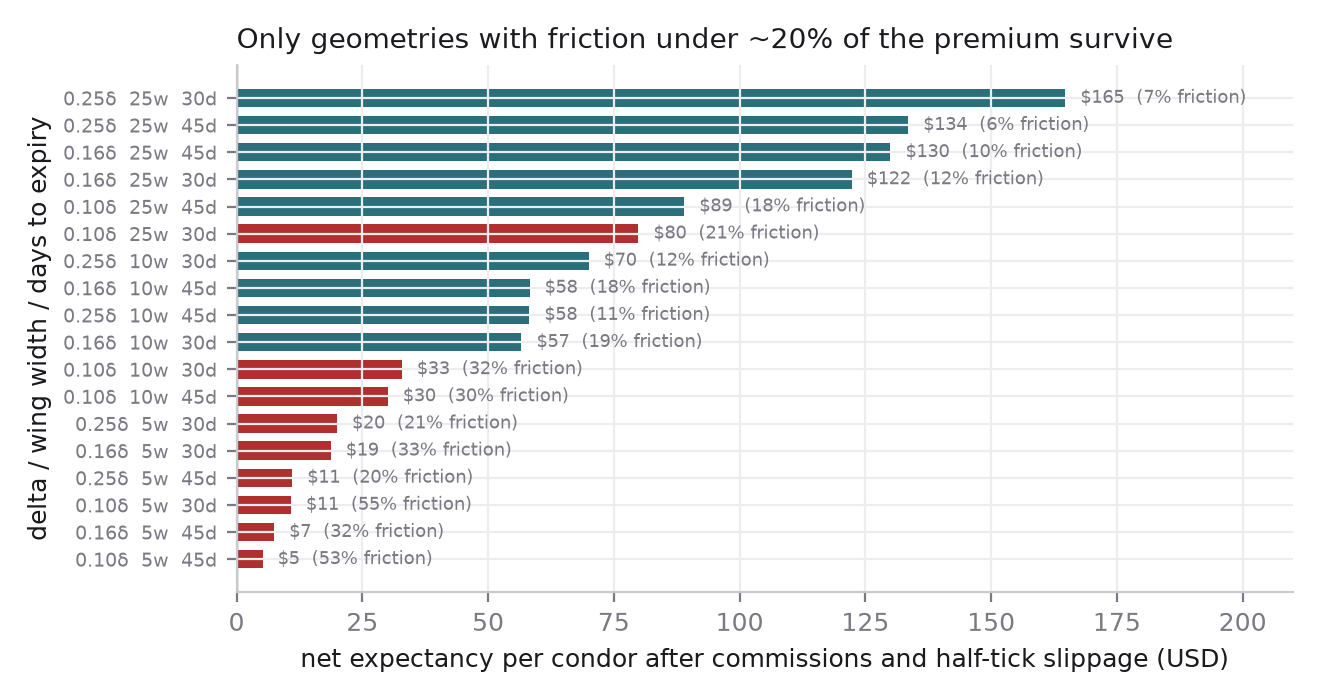
Read the far right column against the middle one. Every geometry with friction above roughly 20% of the premium collected earns less than $30 per condor — and a single bad month is $1,000. The 5-point-wide structures at the top of the table are not conservative; they are expensive.
Eighteen geometries, sorted by net expectancy. Teal bars carry friction below 20% of the premium; red bars above it. The relationship is monotonic, which is why the router enforces a minimum credit rather than a preferred delta.
Implementation rule, not a preference. The entry module computes the condor's credit and compares it to the modelled friction. If friction exceeds 20% of the credit, the order is not sent — regardless of IV rank, delta or how attractive the setup looks. This is the highest-value single line of code in the system.
Sizing
Risk per condor is the wing width times the multiplier — $2,500 for a 25-point XSP condor. Sizing is a fixed fraction of NAV, and the choice of fraction is the most consequential decision in the document.
Risk per trade
Median 12 mo
5th percentile
Median max DD
P(drawdown > 30%)
2.5%
+1.7%
-2.2%
2.1%
0.0%
5.0%
+3.4%
-4.4%
4.3%
0.0%
10.0%
+6.9%
-8.7%
8.6%
0.5%
20.0%
+13.8%
-17.4%
17.1%
14.2%
Doubling the risk quadruples the drawdown and roughly doubles the return — a straight line, not a curve. There is no sizing that improves the ratio, because the ratio is the strategy. 5% is the recommendation for year one: it produces a median drawdown of 4.3% and a 5th-percentile year of −4.4%, both of which a five-person group can sit through without a crisis meeting. 20% sizing is what a group talks itself into after six good months, and it is how the six good months get given back.
Management: what the simulation says, and what to do about it
Retail options literature is near-unanimous that positions should be closed at 50% of maximum profit or 21 days to expiry. The simulation does not support that as a return rule, though it does support it as a risk rule. Both facts matter.
Management rule
Mean P&L
Win rate
5th pct
Worst case
hold to expiry
$109
82.9%
$-1526
$-2143
close at 50% of credit
$-9
86.9%
$-1275
$-2143
exit at 21 DTE
$-59
56.8%
$-559
$-2111
50% TP or 21 DTE
$-62
56.3%
$-561
$-2160
50% TP or 21 DTE, 2× stop
$-58
55.8%
$-545
$-804
The finding: in this model, holding to expiry earns the most and takes the largest single loss. The 50%/21-DTE rule cuts the worst case by a third and gives up most of the expectancy. Adding a 2× stop cuts the worst case to 32% of the risk committed and costs about $8 more per condor than the 50%/21-DTE rule alone — by far the best risk-adjusted trade in the table.
The reason is cost. Closing early means paying to open and to close, twice over, and each close costs roughly 12% of the original credit. The rule that retail traders have found works in practice does work — but it works for people who pay a dollar a leg, not for a model that charges a full tick of slippage on eight leg-events. If your fills improve, the rule improves with them. This is directly testable in the paper phase and it is the first thing to test.
Recommended management policy
Enter at 30–45 DTE. Close at 50% of the credit if it is reached before 21 DTE. Close at 21 DTE regardless. Hard stop at 2× the credit received — that is, a loss equal to twice the premium collected — executed as a limit order, not a market order. The stop is not in the table as an expectancy improvement; it is there because the worst case it removes is the one that ends a club. Accept roughly $60 per condor of foregone expectancy as the premium for a maximum loss of $800 instead of $2,143.
Exceptions the code must handle
Exception
Handling
Partial fill on one leg
The router works as a single combo order. If the combo does not fill, nothing fills. Never leg in — an unprotected leg is prohibited by construction.
One leg fills, the combo is broken
Immediately attempt to close the filled leg. If it does not close within 60 seconds, escalate to the operator and log the event as an incident. This should be rare; it is not impossible.
Quote staleness
No entry if quotes are older than five seconds. Cheap protection against a dead feed producing a plausible-looking trade.
Expiry on a Friday
XSP is European and cash-settled, so there is no assignment and no pin risk. The position simply settles. This is one of the strongest operational arguments for the underlier.
Holiday-shortened week
No new entries in the two sessions before a market holiday; liquidity thins and fills deteriorate.
Broker API timeout
Do not retry blindly. Query the position, reconcile, then act. A blind retry is how one condor becomes two.
Section 08
The crypto sleeve: what survives the fee schedule
The brief gives crypto equal billing with options. On the evidence it should not. The honest allocation is zero while the options sleeve is unproven, and at most a quarter of capital afterwards — and even then, only the funding carry, which is a different strategy from the two the brief names.
What is left after arbitrage and grid are removed
Funding-rate carry is the trade that survives: buy spot, short the perpetual future, collect the funding payment that leveraged longs pay to hold. It is delta-neutral by construction, it has an economic basis (someone is paying for leverage), and it is available to a US person through a narrow but real set of venues.
Funding regime
Gross, $50k
Fees, round trip
Net on notional
Net on capital
4% annualised
$2,000
$150
3.70%
2.47%
8% annualised
$4,000
$150
7.70%
5.13%
Measured 4.90%
$2,450
$150
4.60%
3.07%
The capital column is the one that matters and the one usually left out. To run the trade you need spot inventory and margin against the short perp — roughly 1.5× the notional in total capital. The funding is earned on the notional, so the return on capital is the funding rate divided by that haircut. At the measured 30-day mean of 4.90% annualised, the trade earns about 3.1% a year on capital before tax and before any exchange problem.
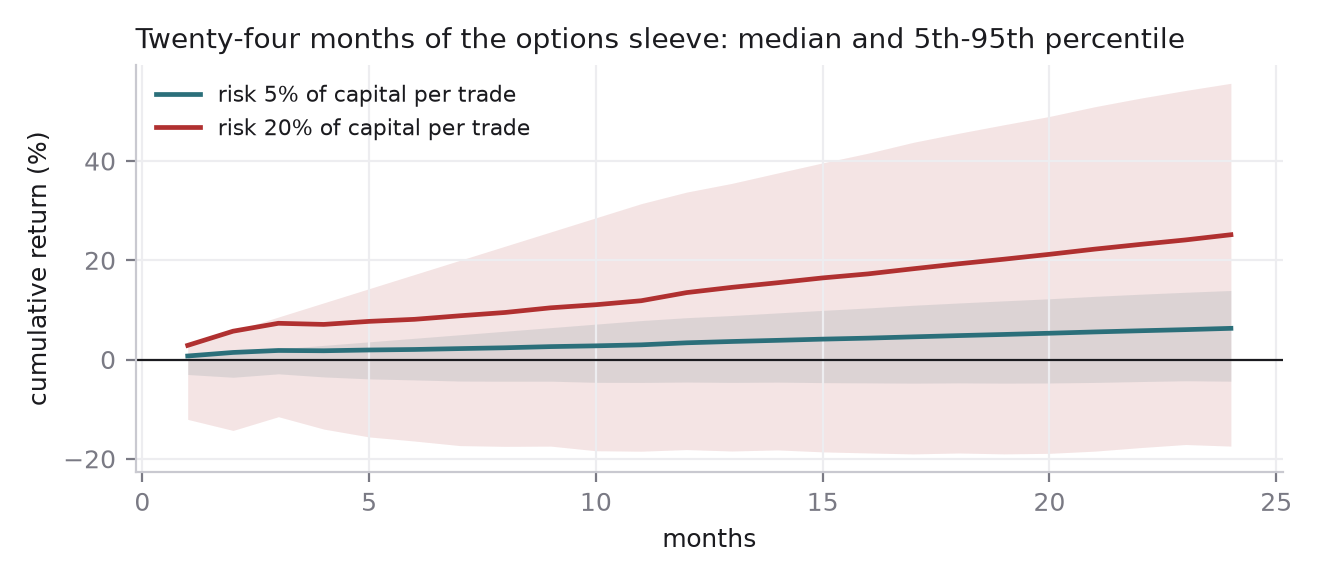
For comparison: the options sleeve at 5% risk sizing (teal) and at 20% (red), twenty-four months, median with a 5th–95th percentile band. The crypto carry sits inside the teal band's lower half — for materially more counterparty risk.
The measured funding, not the advertised one
Funders are advertised as "typically 8–10% annualised". Measured over the last 720 eight-hour periods to 30 October 2026, BTC perpetual funding on the deepest venue averaged 0.004476% per eight hours — 4.90% annualised, median 4.27%, minimum −0.42%, maximum 20.90%, with 96.2% of periods positive. The 20% figures people quote are regime peaks, not the mean, and building a business model on the peak is how the sleeve gets abandoned in its first flat quarter.
Where the two legs can actually be traded
Leg
Venue
Detail
Spot inventory
Kraken Pro, or Binance.US where the pair is listed
Kraken Pro spot is 0.40% maker / 0.80% taker at entry tier, falling to 0.15%/0.30% at $50k of 30-day volume. Binance.US is 0.00% maker / 0.02% taker with no volume requirement — materially cheaper — but pairs and availability are limited. Gemini at 0.60%/1.20% should be excluded on cost.
Short perp
Coinbase Financial Markets
The only CFTC-regulated perpetual-style route for a US person. Nano BTC-PERP at 0.01 BTC (nano ETH at 0.10 ETH), five-year dated contracts, up to 10× intraday, hourly funding, fees "as low as 0.02%" with a $0.15 per-contract minimum. Coinbase's wider offshore perp book is not available to US users.
Not available
Offshore venues
Trading perps on an unregistered venue is a Commodity Exchange Act problem for the venue and an unquantified counterparty problem for you. It also removes any argument that the position is a regulated product.
Note the structural awkwardness: the two legs sit on different venues, so the capital is split across two counterparties and the hedge is not legally netted. If one venue fails while the other holds, you are left with a naked directional position. That is the real risk of this trade, and it is not priced in the funding rate.
If crypto is funded, these are the rules
Separate account, separate venue credentials, separate kill switch. Never in the same margin pot as the options sleeve — see Section 3.
No leverage beyond 2× net. The trade does not need it and the liquidation tail is the whole risk.
Exit the perp if 14-day mean funding turns negative. The entire reason to hold the position has gone; holding it anyway is a directional bet with extra steps.
Rebalance on a schedule, not on a signal. Monthly. An opportunistic rebalance is a discretionary trade wearing a systematic costume.
No offsetting spot/perp pair across 31 December, because it is arguably a straddle and the IRS has issued no guidance.
Cap at 25% of NAV, and count the full notional, not the margin.
What the crypto sleeve is worth, honestly. About 0.75% a year of total NAV at a 25% allocation and the measured funding rate — against which you carry exchange counterparty risk across two venues, an unsettled straddle treatment, and a lot ledger that must be built before the first trade. That is not a reason never to do it. It is a reason to do it last, in its own account, with its own limits, after the options sleeve has proven it can run for a year without an incident.
Section 09
The risk engine: one brain, hard limits, one kill switch
This is the component that makes the difference between a trading bot and a trading business, and it is the one the four frameworks in the brief do not give you. Hummingbot, LEAN and Freqtrade each have some notion of risk; none of them knows about your five members, your NAV, your sleeve allocations, or your drawdown stop.
Architecture: every order passes through one gate
There is exactly one path from a strategy's intent to a broker order, and it goes through the risk engine. Strategies emit intents; the risk engine converts an intent into an order, sizes it, checks it against every limit, and either sends it or logs the rejection with a reason. No strategy has broker credentials.
Layer
Responsibility
Failure it prevents
Portfolio state
Positions, cash, greeks, per-sleeve allocation. Rebuilt from the venue on start, not from a local file.
Contracts = floor(sleeve allocation × risk per trade / risk per contract). Never rounds up.
Silent over-sizing as NAV drifts
Execution
Combo order, limit price at mid, timeout, no legging in, no blind retry.
Half-filled spreads and duplicate orders
Post-trade
Reconcile to the venue within 5 minutes; alert on any difference; write the journal row.
Divergence between book and reality
Kill switch
One function that flattens the sleeve, cancels every working order, and refuses new intents until a human re-arms it with two members present.
Everything else, when it fails
The limits
Control
Limit
Type
Action on breach
Loss per condor
2× credit received
Hard
Close at limit; no re-entry on the same underlier that day
Sleeve drawdown from high-water mark
15%
Hard
Flatten the sleeve, freeze new entries, written review by all five members
Capital at risk per condor
5% of NAV
Hard
Sizer refuses the order
Aggregate short delta
±0.35 of NAV-equivalent
Hard
Block entries on the offending side
Aggregate short vega
0.8% of NAV per vol point
Hard
Block entries above the line
Concurrent condors, same underlier
2
Soft
Second member approval required
Cash buffer, options account
≥ 30% of NAV
Hard
No new entries; reduce if below 25%
Daily loss
3% of NAV
Hard
Halt all entries until the next session
Order rate
20 per minute per account
Hard
Router throttles
Quote age
5 seconds
Hard
Refuse the order
Friction ratio
> 20% of credit
Hard
Refuse the order
Crypto allocation
25% of NAV, full notional
Hard
Transfer back to the options account
Funding regime
14-day mean < 0
Hard
Close the perp, keep the spot
The kill switch has to be a tested thing, not a rumour
Three independent ways to stop the system, and each one tested before capital arrives:
In-code. A flag in the risk engine that the strategies cannot set and cannot read past. Flattens and cancels, then refuses intents.
Out-of-band. A broker-side cancel-all and an exchange-side API key disable, executable from a phone by two members independently. This works when the host is down, which is the case that matters.
Physical. The API keys are disabled at the venue. Slowest, and the only one that survives a compromised operator account.
Test the switch by firing it during the paper phase, on a live paper position, and record the time from trigger to flat. A kill switch that has never been fired is a design document. The acceptable time is under 60 seconds for the in-code path and under 10 minutes for the out-of-band path.
Why five members make the risk engine harder, not easier
With one trader, a limit is a personal rule. With five, a limit is a contract, and the contract has to be enforced by something that cannot be argued with. The most likely failure in year one is not a bad trade — it is a well-meaning member asking the operator to "just let this one run" during a drawdown, and the operator agreeing. The risk engine exists to make that conversation impossible, and the operating agreement exists to make it unnecessary.
Section 10
Technical architecture: what to take from each framework, and what to write
The instinct is to pick one of the four frameworks and build on it. The correct answer is to take three specific things from the ecosystem and write the fourth layer yourself, because the layer you write is the only one that knows about five members, a pooled NAV, and a drawdown stop.
The repo map
Component
Source
What you use it for
What you do not
Research and backtest
QuantConnect LEAN, self-hosted
Chain-level options backtesting: universe selection, expiry handling, multi-leg fills, greeks, assignment. The LEAN CLI ships a paper-trading target and a data-download workflow. Licence is Apache 2.0.
Do not use LEAN as your live trading engine. It is a research environment; running production orders through it adds a large surface area between your risk check and the broker.
Crypto connectors
Hummingbot, as a library
Exchange WebSocket adapters and order-management primitives for the crypto sleeve, if and when it is funded. Apache 2.0 means you can vendor the connectors without publishing your own code.
Do not run its arbitrage or grid strategies. Do not run Hummingbot as the process that owns your capital.
Crypto backtesting
Freqtrade, optional
Historical crypto strategy testing, hyperparameter search. GPLv3 §2 imposes conditions only on conveying, so internal use on club capital is unencumbered — provided you never distribute the bot.
Nothing it provides is uniquely necessary. If you do not already know it, skip it.
Execution and risk
Write it.
Order router, risk gate, position ledger, reconciliation, kill switch, reporting. Roughly 1,200–1,800 lines of Python.
—
Ledger and K-1 data
Write it, or buy it
Lot-level records with 1256 mark-to-market at year end, member capital accounts, NAV history. A fund accountant costs $1,500–$3,500 a year at this size; building it badly costs more.
Do not let the broker's 1099 be your tax record. It will not have the §1256 mark or your member allocations.
The modules you actually write
Module
Lines
Responsibility
state.py
150
Rebuild positions, cash and greeks by querying the venue on every start. The local store is a cache, never a source of truth.
risk.py
250
Every limit in Section 9, in one place, with a machine-readable rejection reason. No strategy may bypass it.
sizing.py
80
Contracts from allocation, risk per trade and risk per contract. Rounds down. Refuses when the credit-versus-friction test fails.
strikes.py
120
Delta-targeted strike selection off the live chain, with rounding to the listed strike grid and a check that the resulting spread is actually quoted.
router.py
300
Combo order construction, limit-at-mid, timeout, idempotent retry, and the rule that a partially filled combo is closed rather than completed.
reconcile.py
120
Every five minutes: venue positions versus book positions. Any difference is an alert, not a log line.
nav.py
150
16:15 ET mark, crypto converted at the same instant, member capital accounts, statement generation.
kill.py
80
Flatten, cancel, refuse. Two-person re-arm.
report.py
200
The one-page daily report and the monthly statement. If a member cannot read the daily report in 30 seconds, it is the wrong report.
journal.py
100
Append-only trade journal written at open and completed at close. This is the audit trail.
That is the whole system, and it is deliberately small: a club trading two condors at a time does not need a microservice architecture, and every extra process is another thing that can silently stop. One Python process, one SQLite file, one cron reconciliation job, one VPS.
Data flow
  broker API ──► state.py ──► risk.py ──► sizing.py ──► strikes.py ──► router.py ──► broker
                     ▲                         │
                     │                         └──► journal.py (intent, decision, rejection reason)
                     │
  venue API ─────────┘
                     │
  reconcile.py ──────┴──► alert on any difference ──► operator

  nav.py (16:15 ET) ──► member statements  ──► quarterly custodian statements cross-check
Two properties of that diagram matter more than the boxes. First, the risk engine sits between every strategy and the broker, so there is no path to the market that bypasses a limit. Second, the state is rebuilt from the venue, so a crashed process comes back knowing the truth rather than believing its own last write.
Why not just fork one of the four
Because the thing you need most is the thing none of them has. LEAN is a research engine with a brokerage abstraction; bolting a pooled-NAV risk layer onto it means working inside a C#/Python hybrid with its own object model and release cycle. Hummingbot's risk primitives are per-strategy and per-connector, not portfolio-level. Freqtrade is built around a single-account crypto model with a fixed stake amount.
Keeping research and execution separate means the research engine can be replaced without touching anything that can move money. That separation is worth more than the code saved by forking.
Section 11
The execution and data stack, priced
Prices below were verified on 30 October 2026 against the vendors' own pages. Where something could not be verified it is marked. The differences that matter are not the ones vendors advertise.
The broker decision
Broker
Cost per 4-leg condor
What it gives you, and what it does not
Interactive Brokers
$8.00
The only candidate combining native combo orders, portfolio margining on defined-risk spreads, and one account for the whole operation. $0.65/contract tiered, but the $1.00 per-leg order minimum applies to each leg of a combo, so a 1-lot condor round trip is $8.00, not $5.20. Portfolio margin needs $110,000 net liquidation to open and $100,000 to maintain — so a $50k club stays on Reg-T until it crosses that line. OPRA L1 is $1.50/month non-professional, waived above $20/month of commissions.
Tradier Pro
$0.62
$10/month and $0.00 per contract on equity options, with documented four-leg spread support and a free paper sandbox. The cheapest verified path by an order of magnitude. Caveat: the sandbox fills against 15-minute delayed data, so paper results are an upper bound on reality. Index options are $0.35/contract.
tastytrade
$4.00
$1 per contract to open, $0 to close, $10 per-leg cap. Options-native platform and a sensible backup if IBKR approval is slow.
Schwab
$5.20
$0.65/contract, no multi-leg API parity worth building against.
Alpaca
—
Zero commission, but its documented options ceiling is Level 3, which covers long spreads only. Iron condors cannot be placed programmatically at all. Exclude.
The counter-intuitive conclusion. Broker choice moves a condor's friction from $45 to $41 — because at one lot the friction is almost entirely slippage, not commission. The real lever is order placement: work the mid, use combo orders, never take a marketable fill, and prefer a 25-point wing over a 5-point wing. Shopping brokers for $7.40 a condor while paying $40 in slippage is optimising the wrong term.
Data: the one line item that can surprise you
Source
Cost
What it is
QuantConnect Cloud, AlgoSeek US equity options
$0 to backtest
4,000 symbols, minute/hour/daily, from January 2012, free in the cloud. Downloads are metered in QuantConnect credits. This is the correct entry point: do not buy data until a strategy is funded.
QC bulk downloads
$720/yr – $30,000
Daily updates $720/year; minute updates $1,200/year; full one-off archives from $12,000 (daily) to $30,000 (minute). Stay in the cloud.
ThetaData, Options Standard
$80/mo
10 years of OPRA NBBO tick data, 4 concurrent requests. The cheapest credible way to own your own chains for local research.
Polygon (now Massive)
$29–$199/mo
Options plans start at $29 for four years of history. Adequate; less complete than ThetaData on OPRA.
ORATS
$199–$899/mo
Cleaned greeks and an IV surface rather than raw OPRA. Useful once you are doing surface work; overkill before.
Databento
$0 usage, $1,750/mo Plus
Usage-based $/GB on the Standard tier. Licence fees only matter if you redistribute.
Cboe DataShop
—
Quote-on-request; no published price. Skip.
Hosting and the rest of the year-one stack
Item
Monthly
Note
VPS (2 vCPU, 4 GB, US-East)
$20–$60
Must not be a laptop. The bot has to run on a Tuesday when the operator is on a plane.
Uptime and heartbeat monitoring
$0–$15
A push notification when the process stops. This is the highest-value $10 in the budget.
Secret management
$0–$15
API keys in an encrypted store, not in a config file on the VPS.
Off-site backups
$5
The SQLite ledger and the journal. Losing the ledger means losing the tax basis.
Broker market data
$1.50
IBKR OPRA L1 non-professional, waived above $20/month of commissions.
Research data (optional)
$0–$80
Only if you outgrow the free cloud backtests.
Total infrastructure: $30–$180 a month, depending on whether you buy data. Against a $100,000 book that is 0.4% to 2.2% of capital a year, which is larger than the strategy's expected edge at small sizes — another argument for reaching $250,000 of pooled capital before adding fixed costs.
Library choices, and one trap
Library
Status
Use
ib_async
Maintained — v2.1.0, pushed October 2026
The maintained fork of ib_insync. Use this.
ib_insync
Archived — last push March 2024, last release 2023
Do not start a new project on it. It is still the most-copied tutorial code on the internet, which is exactly why it is a trap.
ccxt
Active — 4.5.91
Crypto exchange access if you do not use Hummingbot connectors.
lean CLI
Active — 1.0.233
Research workflow and cloud backtests.
Section 12
Operations: the runbook nobody writes until it is too late
An automated book fails in three ways: the strategy stops working, the software stops working, or the people stop agreeing. The runbook addresses the first two on a schedule and the third by having written the answer in advance.
The calendar
When
What
Done when
Daily 16:30 ET
Reconciliation and daily report
Venue positions equal book positions; cash equals expectation; the one-page report is in the shared channel. Discrepancy of any size escalates to an incident.
Daily
Fill quality check
Realised slippage is within 50% of the model's assumption. Drift beyond that invalidates the backtest and is a gate failure, not a curiosity.
Friday
Expiry handling
Any position expiring this cycle is either intentionally held to settlement or closed. No position is allowed to reach expiry without a recorded decision.
Weekly
Regime review
IV rank, term structure, realised versus implied, and whether the entry filter is selecting trades. Written note, five lines.
Monthly
NAV and statements
16:15 ET mark struck, member capital accounts updated, statements issued, custodian statement reconciled. Crypto, if live, rebalanced on schedule.
Quarterly
Governance meeting
Performance against model, limits hit, incidents reviewed, withdrawal window opened and closed, any strategy change voted and minuted.
Annually
Full review
Independent balance verification, tax filings, insurance renewal, and a written decision to continue, change or stop.
NAV: the definition that everyone will argue about
Five members and one NAV means one definition, written down. The defensible one:
Timestamp: 16:15 ET on the last business day of the month. Options are marked at the mid of the closing quote; crypto is converted at the same instant from a single named venue.
Basis: mark to market, not cost. The partnership is already marked for tax under §1256, so a cost-based NAV would be a second, incompatible set of books.
Costs: accrued, not paid. Commissions, data and hosting are deducted in the month they are incurred.
What it is not: it is not a redemption price. Withdrawals happen at the next quarter-end NAV after the notice period, which protects the remaining members from a departing member timing the mark.
Incident response: five scenarios, written in advance
Scenario
First action
Then
Reconciliation mismatch
Halt new entries immediately. Do not "look into it".
Determine which side is wrong — venue is authoritative — correct the book, log the incident, and identify why the check did not catch it earlier.
Partial combo fill
Close the filled leg within 60 seconds.
If it will not close, treat as an unprotected position: place a protective order manually and call the second member.
API or feed outage
Positions are already at the venue and are not at risk from your software being down.
Do not restart repeatedly. Verify state, restart once, reconcile before re-enabling entries.
Drawdown limit hit
Kill switch, flatten, freeze.
Written review by all five within five business days. Re-arm requires unanimity and a documented change, not a mood.
Operator unavailable
Second member holds the out-of-band cancel and the broker password in escrow.
The system runs unattended by design; the only thing needing a human is an exception. Define the maximum unattended period — 5 business days is reasonable — after which positions are flattened.
The clauses people skip
Key-person. What happens if the operator dies, is incapacitated, or simply quits? The operating agreement needs a named successor with the technical access, a documented break-glass procedure, and a rule that the sleeve is flattened rather than run by someone who has not been trained. This is the least pleasant paragraph in the document and the most expensive to omit.
Credentials. Not in one person's password manager. Two members hold the broker credentials; the exchange API keys are trade-only and held in a shared encrypted store with access logging; the second factor for the broker is on a device the operator does not solely control. The operator should be able to trade and unable to withdraw — that is the whole design.
The maximum unattended period. An automated system left alone for three weeks is not "running itself", it is unmonitored. Pick a number, write it down, and make the default action flatten rather than continue.
The unglamorous truth about operations. Over a two-year horizon, the probability that the club loses money because of a software or process failure is comparable to the probability that it loses money because the strategy stops working. The difference is that the software failure is preventable with a checklist, and the strategy failure is not.
Section 13
Governance: the clauses that stop a bad month becoming an ending
Five people will agree enthusiastically at formation. The document that matters is the one they wrote when they still liked each other, because it is the one that governs the quarter when they do not.
The operating agreement, clause by clause
Clause
What it must say
The failure it prevents
Purpose and strategy mandate
The entity trades defined-risk broad-based index option spreads and, separately, a capped crypto carry sleeve. It does not trade naked options, single-name equities, or anything outside the approved root list without a unanimous written amendment.
Drift into a different, unagreed strategy after a losing quarter
Capital contributions
Amount, date, form (cash only), and the rule that no member may contribute more without a vote — because a member who can add capital can also buy influence.
Informal top-ups that break the capital accounts
Withdrawals
Quarterly window, 30 days' written notice, priced at the quarter-end NAV, subject to a 30% cash buffer. No withdrawals during a drawdown halt.
A member exiting at a favourable mark and leaving the rest with the tax
Drawdown stop
At 15% from the high-water mark the sleeve is flattened and frozen. Re-arming requires unanimity and a written change to the strategy or the limits.
The single most important clause. Without it, the response to a drawdown is a debate, and the debate is held by people in a bad mood.
Decision rights
Strategy changes and limit changes: unanimous. Day-to-day trading: the operator alone, within the limits. Individual trades: nobody votes, ever.
Five people managing two condors
Compensation
No management fee. Profits split by capital account. Expenses pro rata and capped at an annual budget approved in January.
The fee that converts a club into a regulated advisory relationship
Authority matrix
Who may place orders, who may move funds, what requires two signatures. The operator can trade and cannot withdraw.
The single-key failure
Removal of a member
Process, valuation, and whether a removed member's units are bought at NAV or at a discount. Decide now; it is unspeakable later.
A deadlock that freezes the account
Key person and succession
Named successor, break-glass access, and the rule that an untrained successor flattens rather than trades.
The operator's absence becoming an emergency
Amendment
Unanimous for strategy, limits, fees and admission of new members. Majority for administrative matters.
A 3–2 vote changing the strategy mid-drawdown
Dispute resolution
Mediation first, then arbitration in the county of formation. Not litigation.
Five friends in a courtroom
The investment policy statement, in one page
The operating agreement is the legal instrument; the IPS is the operating one. It should be one page, and it should contain exactly this:
Objective. Target 3–5% annual return on NAV with a maximum sleeve drawdown of 15%. Explicitly not an income strategy and explicitly not expected to beat an index fund on total return.
Instruments. Defined-risk index option spreads on XSP and SPX. Approved root list enforced in code.
Sizing. 5% of NAV at risk per position in year one; 10% maximum thereafter by unanimous vote.
Reporting. Daily one-page report, monthly NAV and statements, quarterly meeting, annual review.
Prohibited. Naked options; ETF or single-name options; leverage above 1.0× net in the options account; crypto above 25% of NAV; any transfer between sleeves without two signatures.
Review trigger. A drawdown of 15%, or two consecutive quarters below the model's 5th percentile, forces a written review and a unanimous decision to continue, change or stop.
The clause that matters most
Write the drawdown stop before the first trade, and make re-arming require unanimity. Everything else in the governance section is good practice. This one is the difference between a strategy that has a bad year and an entity that ends — because the moment a short-premium book is at its drawdown limit is precisely the moment five people are least able to make a clear decision, and the default, absent a written rule, is to double down.
Section 14
The 90-day build plan, with gates
The plan is organised around gates rather than dates, because the failure mode of a build like this is moving forward on schedule when a gate has quietly failed. Each phase ends with evidence a fifth party could check.
Phase
Window
Work
Gate
Owner
0 Foundation
Weeks 1–4
Engage counsel and a CPA; choose Path A or B; file Articles, EIN, operating agreement with the authority matrix and the drawdown clause, subscription documents, 506(d) screen; open the brokerage account in the LLC name. Nothing trades.
G0
Lawyer, CPA, all five
1 Research
Weeks 3–8
LEAN locally; XSP chains over several years; strike selection, sizing and the entry filter as pure functions; reproduce this Monte-Carlo on real chains. If the real-chain result is materially worse, stop here.
G1, G2
Technical lead
2 Execution
Weeks 6–10
Router, risk gate, reconciliation, kill switch, journal, one-page daily report. Fire the kill switch as a test.
G3
Technical lead
3 Paper, canary
Weeks 8–12
60 sandbox sessions including one full expiry cycle, then live at 10% for three months with a weekly variance note.
G4
All five
4 Full size
Month 4+
Only after G5. Crypto stays on paper until the options sleeve has run twelve months inside its limits.
G5
All five
The gate most likely to fail is G1. Synthetic-options backtests — building a chain from implied vol and a model — systematically overstate a short-premium strategy, because they generate a smooth volatility surface that does not exist on the day you most need to trade. If the real-chain result is half the synthetic result, that is not a reason to adjust the model; it is the model telling you the truth about the edge.
What it costs to get to G3: roughly $6,000–$11,000 and three months of part-time work, before a dollar is at risk — the entry fee for doing this in a form that survives contact with a loss, and the number to quote to any member who asks why the first trade is not this week.
The gates, defined
Gate
Name
Pass condition
G0
Legal and tax sign-off
Entity formed, operating agreement executed, subscription documents signed by all five, 506(d) screen complete, and the CPA has agreed the XSP/§1256 treatment in writing.
G1
Data honesty
The backtest uses point-in-time chains with quotes, not synthetic mids. No look-ahead in strike selection or the IV-rank filter. Three sampled days reproduce by hand from the raw data.
G2
Cost realism
Every backtest run at 0, 1× and 2× modelled friction. The strategy must remain positive at 2×. A strategy that dies at twice the cost was never an edge.
G3
Paper trading
60 consecutive sessions on the sandbox with the real router, at least one expiry cycle, zero unexplained rejects, fill slippage within 50% of the model, and a kill-switch test with a recorded time-to-flat.
G4
Canary
Three months live at 10% of target size. Realised expectancy within one standard error of the model. Any fill-quality drift beyond 50% is a fail, not a note.
G5
Full size
Unanimous written sign-off by all five members, with the drawdown stop already in the executed agreement.
Section 15
Capital ladder and go/no-go
Sizing the strategy is one decision. Sizing the entity against its fixed costs is another, and at small capital the second one dominates.
The ladder
Stage
Deployed
What runs
Hard limit
Stop trigger
S0
0%
Paper only. Sandbox execution, real router, real limits. Nothing at risk.
No capital
G3 evidence on file
S1
10%
Canary. One condor, one expiry bucket, 1-lot.
≤1% of capital at risk per trade
3 months, realised within 1 SE of model
S2
40%
Target risk, single underlier, two concurrent positions.
5% at risk per condor
Sleeve drawdown 15%
S3
100%
Full options sleeve. Steady state for the first two years.
5% per condor; 15% sleeve drawdown
Any limit breach
S4
100%
Crypto carry added, separate account, paper first.
25% of NAV, full notional counted
Funding negative for 14 days
The arithmetic nobody wants to do
At $100,000 of pooled capital, the strategy's expected return is about $3,400 a year at median and 5% sizing. The one-off cost of doing this properly is $7,400 to $19,500. The structure therefore costs between two and six years of expected return before it has paid for itself.
Pooled capital
Median annual return
Year-one setup cost
Years of return consumed
$50,000
$1,700
$7,400–$19,500
4.4 – 11.5
$100,000
$3,400
$7,400–$19,500
2.2 – 5.7
$250,000
$8,500
$8,900–$21,000
1.0 – 2.5
$500,000
$17,000
$10,000–$23,000
0.6 – 1.4
Three honest conclusions follow. Below roughly $100,000, the correct structure is Path A — a genuine club with all five members active and an unpaid operator — because the fund structure costs more than the edge. Between $100,000 and $250,000, the decision is close and depends on whether the members value the liability shield and the formality enough to pay for them. Above $250,000, Path B is clearly correct and portfolio margin becomes available at Interactive Brokers, which improves the return on the same risk.
What is not honest is pretending that a $50,000 club running this strategy is a business. At that size it is a structured hobby with legal costs, and the members should decide that with their eyes open.
Go / no-go
Criterion
Gate
Status
Evidence required
Entity and offering documents executed
G0
Not started
Signed documents on file
506(d) screen for all five members
G0
Not started
Written questionnaire, reviewed
CPA agreement on §1256 / XSP treatment
G0
Not started
Written memo
Backtest on real chains, not synthetic mids
G1
Not started
Three days reproduced by hand
Positive at 2× modelled friction
G2
Not started
Three cost runs side by side
60 clean sandbox sessions
G3
Not started
Session log, zero unexplained rejects
Reconciliation job proves book = venue
G3
Not started
5-minute check running, alert tested
Kill switch fired and timed
G3
Not started
Time-to-flat recorded, under 60 seconds
Canary quarter within 1 SE of model
G4
Not started
Variance note signed by all five
Drawdown stop signed by all five
G5
Not started
Executed operating agreement
Section 16
Year-one budget
Two columns, because the range is real: the low column assumes Path A and no insurance, the high column assumes Path B with a securities lawyer, a CPA, and D&O coverage.
The single largest line, and the one most worth not economising on
CPA — Form 1065, K-1s, §1256 memo
$1,500
$3,500
Year one includes setup; later years are lower
Broker commissions, 12 condors
$96
$96
IBKR $8.00 per round trip
Broker market data (OPRA L1)
$18
$18
Waived above $20/month of commissions
Research data
$0
$960
$0 if the free cloud backtests suffice; $80/mo for ThetaData
VPS and hosting
$240
$720
$20–$60/month
Monitoring, backups, secrets
$120
$360
The cheapest insurance in the budget
Exchange fees, crypto (if live)
$0
$300
Zero if crypto stays on paper, which is the recommendation
Florida annual report
$139
$139
1 January – 1 May; $538.75 if late
D&O and fidelity bond
$0
$2,500
Optional while nobody is paid; effectively mandatory after
Subtotal
$6,738
$17,718
Contingency, 10%
$7,412
$19,490
Total year one
What the budget implies
The infrastructure is not the cost; the paperwork is. Commissions, data and hosting together come to $474–$2,274 a year. Legal and accounting come to $6,000–$12,500. A group optimising the technology and economising on the documents has optimised the wrong 20%.
The recurring cost after year one drops sharply — to roughly $1,000–$2,000 for a club that never takes outside capital and never pays anyone, and to roughly $6,000–$9,000 for a formal fund with a CPA and insurance. That difference is the price of the structure, and it is worth paying only if the structure is doing something for you.
Nothing here includes a management fee, and that is deliberate. Any fee changes the Advisers Act analysis, breaks the CFTC's no-compensation exemption, and adds an audit-trail obligation that costs more than the fee is likely to be worth at this size.
Section 17
What would falsify this
A proposal that cannot be disproved is a sales document. These are the observations that should end the project, or force it back to research, stated in advance so that nobody has to be the person who says it after the loss.
#
Observation
What it means
1
Real-chain backtests produce less than half the synthetic result
The synthetic model is generating a volatility surface that does not exist. Stop at G1. The edge was an artefact of the data generator.
2
The strategy turns negative at 2× friction
It was never an edge; it was a cost assumption. Stop at G2.
3
Realised slippage exceeds twice the modelled $45 per condor
The fills are worse than the model assumed and every number in this document is optimistic by that factor. Return to research on order placement before returning to capital.
4
IV rank stays below 25 for a full quarter
The entry filter is doing its job and there is no trade. This is not a failure — but if the filter blocks entry for four consecutive quarters, the strategy has no capacity in the current regime and the capital should be doing something else.
5
Two consecutive quarters below the 5th percentile of the model
Roughly a 1-in-400 event under the model. The model is wrong. Halt and re-derive, do not "give it another quarter".
6
The 15% drawdown stop is hit
The strategy has produced a loss the sizing did not anticipate. Unanimous written decision to continue, change or stop — and the default is stop.
7
An incident where the book and the venue disagree for more than one session
The reconciliation layer is not working, which means nothing else can be trusted. Halt until it is fixed and proven.
8
A member asks to make an exception to a hard limit
The governance has failed. The answer is written in the operating agreement and the correct response is to read it aloud, not to vote.
9
The club needs the money within 12 months
This is not a liquid strategy at the sleeve level and never will be. If any member's capital is needed inside a year, it should not be in the pool.
The sentence to remember
This is a 3–5% a year strategy with a 15% drawdown budget that exists to be boring. If at any point it stops being boring — if the returns look better than the model, if a month produces double the expected premium, if someone proposes "just this once" — that is the signal that the process has drifted, not that the strategy has improved.
Appendix A
Definitions, repository map, sources
A.1 Metric definitions
Term
Definition as used in this document
Credit
The net premium received when selling a condor, in index points, multiplied by 100 for dollars.
Risk
Wing width in points times the multiplier. The maximum loss before friction. For a 25-point XSP condor, $2,500.
Friction
Commission plus slippage across all leg-events of a round trip: four legs to open, four to close. Modelled at $45.20, of which $8.00 is real IBKR commission and the remainder is slippage at one full tick per leg.
Friction ratio
Friction divided by the premium collected. The single best predictor of whether a geometry works.
Win rate
Fraction of simulated months with positive P&L after friction.
Expectancy
Mean P&L per condor after friction. The number the whole document is about.
Variance risk premium
Implied volatility minus subsequent realised volatility. The economic source of a short-premium edge; modelled at 15% implied against 12.8% realised.
IV rank
Where current implied volatility sits within its own trailing one-year range, as a percentile.
NAV
Net asset value, marked at 16:15 ET on the last business day of the month, all sleeves converted at that instant.
Drawdown
Peak-to-trough decline in NAV from the high-water mark, measured on month-end marks.
Defined risk
Maximum loss fixed at entry by a protective long option on every short leg. Not a synonym for low risk.
A.2 Simulation assumptions, stated plainly
Every number attributed to the strategy comes from sim/club_sim.py. The assumptions that matter, and their limits:
Pricing: Black-Scholes with a constant entry volatility of 15%, a 4% risk-free rate, and a strike grid rounded to one index point. Real chains have skew and term structure; this model does not, which flatters the wing legs slightly.
Volatility response: implied vol is assumed to rise by roughly 12× the percentage decline in the underlying and fall by 2× the percentage advance, clipped to between 0.5× and 3× the entry level. This is a heuristic calibrated to the VIX's historical response, not a fitted surface.
Path generation: daily log-normal steps, plus a Student-t(4) variant for fat tails, plus a jump mixture with a 1.5% monthly chance of an 8% gap. The jump model is the closest to a real crash and it still understates a March 2020.
Costs: $45.20 per condor, applied as entry friction on all paths and additional exit friction on any path that closes early.
What is not modelled: early assignment (XSP is European, so this is correct for the recommended underlier but not for SPY), pin risk, liquidity gaps at the wing strikes, and the tax consequence of any individual path.
The honest summary: the model is directionally right and numerically optimistic. Its job is to rank geometries, management rules and sizing levels, and it does that reliably. It is not a substitute for G1, and Section 17 says so.
Monte-Carlo, cost ladders, geometry sweep, sizing, carry and arbitrage arithmetic
sim/figures.py
The four figures
sim/build_workbook.py
The workbook generator
results.json
Every simulation output, keyed by scenario
arrays.npz
Raw P&L draws used for the figures
To regenerate everything: uv venv .venv && uv pip install numpy scipy matplotlib openpyxl, then ./.venv/Scripts/python.exe sim/club_sim.py, sim/figures.py, sim/build_workbook.py. Runtime is about ninety seconds on a laptop.
A.4 Sources
#
Source
Claim it supports
1
SEC Office of Investor Education, Investment Clubs and the SEC
Club structure; adviser compensation caveat
2
SEC Division of Investment Management, Frank Mason (3 Jul 1996)
"Even a few passive members" may make interests securities
3
SEC Division of Investment Management, Maxine Harry (6 Dec 1995)
Active-member club outside the 1940 Act
4
Investment Company Act §3(c)(1), 15 U.S.C. §80a-3(c)(1)
Prepared 30 October 2026. This document is an engineering and structuring analysis, not investment, legal or tax advice. The legal and tax sections are checklists to take to a Florida securities lawyer and a CPA who files Form 1065; they are not opinions and should not be relied on as such. All strategy figures come from a Monte-Carlo model whose assumptions are stated in A.2 and whose limitations are stated in Section 17.